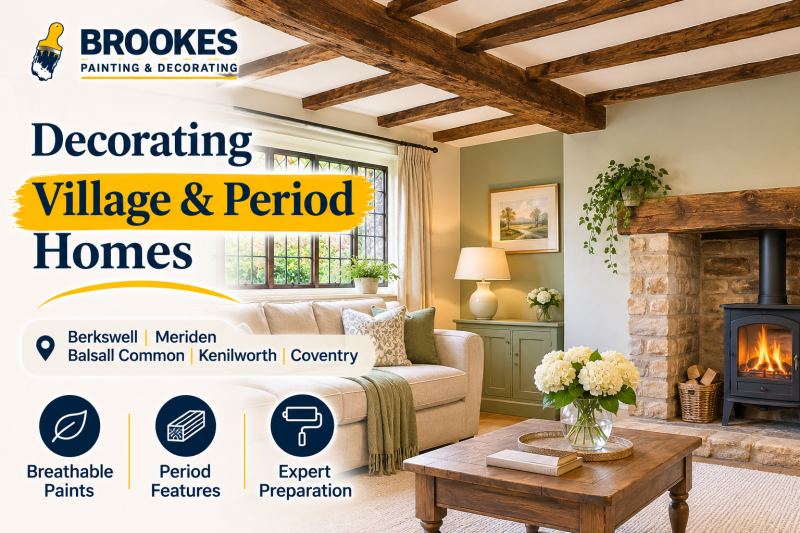
Quick answer: older village homes need breathable paint, gentle preparation and a decorator who looks at the building before opening a tin. Solid walls, lime plaster, oak beams and uneven surfaces behave differently from a modern plasterboard house, and the wrong product can trap moisture and cause the very damage you are trying to hide.
Drive through Berkswell, Meriden or Balsall Common and you pass a real mix of homes: brick cottages, farmhouses, Victorian and Edwardian villas, interwar semis and newer estates. The same is true in Kenilworth and around the edges of Coventry. Each type has its own quirks, and the older ones in particular reward a careful approach.
This guide covers what we look for when we decorate period and village properties, how to choose paint that suits older walls, and what to check before you start. As a family run business working across Coventry, Kenilworth, Meriden, Berkswell and Balsall Common since 2005, these are the questions homeowners ask us most.
Why Older Village Homes Need a Different Approach
A house built in the last thirty years is usually made from plasterboard, modern plaster and cavity walls, and it is designed to keep moisture out. An older property was built the opposite way. Solid brick or stone walls, lime mortar and lime plaster were designed to absorb moisture and let it evaporate again, so the building could breathe.
When a breathable wall is sealed with a plastic based paint or a cement based repair, moisture can no longer escape. It builds up behind the coating, and you see the result as bubbling paint, flaking plaster, salt staining or persistent damp patches. This is one of the most common causes of "damp" in period homes, and it is often misdiagnosed as rising damp. Our guide to decorating older homes across Coventry explains the pattern in more detail, and our guide to damp and mould before redecorating covers how to tell the different types of damp apart.
Reading the Building Before You Choose Paint
Before we recommend any product, we look at how the house is built. A few simple checks tell us a great deal.
Wall construction. Solid walls, often around nine inches or thicker, with no cavity, suggest a traditional build. Lime plaster tends to feel slightly softer and more irregular than modern gypsum plaster, and it often has a gentle, uneven surface.
Previous paint. Layers of vinyl silk or plastic masonry paint on a lime wall are a warning sign. We check whether the existing coating is lifting, which tells us whether moisture is already trapped.
Cracks and movement. Hairline cracks are normal in older buildings and are usually cosmetic. Wider or growing cracks deserve a separate opinion before decorating.
Ventilation. Blocked chimneys, sealed up airbricks and modern replacement windows can all change how a period house handles moisture, sometimes for the worse.
This assessment is why we always recommend an in person visit for older properties, rather than quoting from photographs. It is the same honest, assessment led approach we describe in our guide to choosing a trustworthy painter and decorator.
Breathable Paints and Finishes for Solid Walls
Choosing a paint for an older wall is less about the colour and more about how the product behaves. The main options are worth understanding.
Breathable emulsions. Several manufacturers make emulsions designed to let water vapour pass through, often sold for period properties. They suit most interior walls in older homes and are far kinder to lime plaster than standard vinyl silk.
Limewash. A traditional, highly breathable finish made from lime. It has a soft, chalky, slightly variable look that many owners of period homes love, and it suits original lime plaster particularly well. We cover it, alongside other traditional finishes, in our guide to decorative and textured wall finishes.
Mineral and clay paints. These bond chemically to the wall and stay breathable. They have a distinctive matte depth, though they are less washable than a modern durable emulsion.
Standard emulsion. On modern plasterboard extensions or re-plastered rooms, ordinary quality emulsion is perfectly fine. Many village homes are a mix of old and new, so one house may need two different approaches.
The principle is simple: match the paint to the wall, not to the brochure. Historic England's technical advice explains how traditional buildings handle moisture and why breathability matters, and it is a useful reference for anyone caring for an older property.
Oak Beams, Timber Frames and Original Joinery
Exposed oak beams are one of the great pleasures of an older home, and one of the easiest things to get wrong. The temptation is to seal, varnish or paint them. In most cases, the better advice is restraint.
Old oak is a stable, characterful material that has survived for centuries without modern coatings. Covering it with a heavy varnish can trap moisture, change its appearance and be difficult to reverse. Light cleaning with a soft brush and a gentle product, and a breathable wax or natural oil where a finish is wanted, usually suits better. If beams are blackened or heavily stained, the right approach depends on the cause, and it is worth getting advice before using anything aggressive.
Original doors, panelling, window frames and staircases deserve similar care. Where paint is flaking, it should be taken back carefully, and anything dating from before 1960 should be treated as possibly containing lead paint, as we explain in our guide to timber windows and doors.
Low Ceilings, Uneven Walls and Awkward Angles
Period cottages and farmhouses rarely have straight walls or level ceilings. That is part of their charm, but it affects decorating in practical ways.
Uneven surfaces catch light differently, so a glossy or silk finish will highlight every ripple. A matt or soft matt finish is usually kinder, softening shadows and hiding the natural irregularity. Low ceilings benefit from a light, soft colour overhead, and beams often look best when the ceiling between them is a simple, pale tone.
Awkward angles, sloping ceilings and deep window reveals take more time to cut in neatly. Planning for that, rather than rushing it, is what separates a finish that looks considered from one that looks hurried. Our interior paint guide for Coventry homes covers how sheen affects imperfect walls in more detail.
Fireplaces, Chimney Breasts and Log Burners
Many village homes have a working fireplace, inglenook or log burner, and these bring their own decorating considerations.
Soot and smoke staining can bleed through ordinary paint, so a stain blocking primer is often needed on walls and ceilings near a fire. Chimney breasts can also hold moisture, particularly where a flue has been capped, and persistent damp patches on a chimney breast are worth investigating before repainting. Where a log burner is used regularly, a matt, easily cleaned finish on nearby walls copes better with dust, and heat resistant paint should be used on stove surrounds and flues.
A chimney breast is also a natural focal point, and a good place for a confident colour or a decorative finish, in line with the ideas in our guide to colour trends for Coventry homes.
Conservation Areas, Listed Buildings and Permissions
Some older homes in this part of the West Midlands sit in conservation areas, and some are listed. That can affect what you are allowed to change, especially outside. Different parts of the area are covered by different councils: Coventry City Council, the district council for Kenilworth, and Solihull Metropolitan Borough Council for the villages of Meriden, Berkswell and Balsall Common.
Interior decorating usually doesn't need permission, though listed buildings can have restrictions on some internal work. Exterior changes, such as repainting render in a new colour, replacing windows or altering original features, may need consent. The Planning Portal is a good starting point, and your local council's conservation officer can confirm whether your property is listed or in a conservation area.
If you are not sure, ask before you buy paint. It is far easier to check first than to reverse a change afterwards.
Exterior Care for Village Homes
Exterior work on an older home follows the same principles as interior work: breathable materials, careful repairs and the right timing. Render, brickwork and timber all need different treatment, and a coating that suits modern masonry can harm lime render.
Weather matters just as much as products. Our guide to exterior painting timing in Coventry explains why the spring to early autumn window gives the best results, and why work in cold, damp conditions tends to fail. Village properties often have more exposure than town houses, with open fields, wind and fewer sheltering buildings, which makes a good weather window even more valuable.
For gates, fences, outbuildings and garden timber, which are common in village plots, see our guide to garden fencing and exterior wood care.
Colour Choices That Suit Village Homes
Period homes often look best in colours that feel connected to their surroundings. Soft stone, warm whites, muted greens, gentle greys and earthy tones suit brick and timber, and they sit comfortably alongside rural views and gardens.
Light also matters. Small cottage windows and low ceilings mean less daylight, so very dark colours can feel heavy, while deep colours work well in rooms that are used in the evening, such as a snug or dining room. Whatever you choose, test large samples on the actual wall and look at them morning and evening, because period rooms change character dramatically through the day.
Practical Rural Considerations
Decorating in a village or rural setting has some practical differences from decorating in a city.
Dust, mud and pets. Country homes tend to see more boots, dogs and muddy paws. Durable, washable finishes in hallways and boot rooms save a lot of repainting, as we explain in our guide to staircase and hallway decorating and our guide to pet friendly decorating.
Access. Narrow lanes, gravel drives and limited parking can make deliveries and access more complicated. Mentioning this early helps us plan.
Outbuildings and extensions. Many village plots include garages, barns or garden rooms, which can be decorated or converted. See our guide to garage conversion decorating and our guide to home office and garden room decorating.
Older heating systems. Some rural homes use oil or solid fuel heating, which can leave soot or residue that needs treating before repainting.
Extensions and Mixed Age Properties
Many village homes have been extended over the years, so a single property may have a Victorian core, a 1960s side extension and a modern kitchen. These joins are where decorating problems appear, because different materials move and breathe differently. We cover the transition between old and new in our guide to decorating after an extension or loft conversion.
The practical lesson is to treat each part of the house on its own terms, rather than applying a single product everywhere.
What a Typical Visit Looks Like
When a homeowner in Berkswell, Meriden, Balsall Common, Kenilworth or Coventry asks us to look at an older property, a visit usually follows a straightforward pattern. We walk through the rooms with you, look at the walls, ceilings and woodwork, and ask about the history of the house and any previous repairs or damp.
We then explain what we see in plain terms: which walls are likely to be lime, where moisture may be an issue, and which surfaces need special care. We agree a written scope, discuss the right paint systems for each area, and plan the order of work so the household can keep using the house comfortably. Our approach to sequencing follows the principles in our guide to the right order for a whole house renovation.
Why Use a Local Decorator
A decorator who works regularly across Coventry, Kenilworth, Meriden, Berkswell and Balsall Common sees the same housing types again and again, and learns which approaches work in them. Local knowledge also means practical things: knowing the roads and access, understanding local conservation arrangements, and being close enough to return quickly if a small issue appears after a job.
Brookes Painting & Decorating is a family run business with full public liability insurance and a current DBS certificate. We have worked in homes of all ages, and we are happy to explain what we recommend and why.
Seasonal Timing for Village Properties
Village and rural homes often sit more exposed than town houses, so the season you choose changes the result. Interior work suits late autumn and winter when the weather is poor outside, provided rooms are kept warm and ventilated so paint can dry. Exterior work belongs in the drier, milder months. Planning both around the weather, rather than around a convenient date, is one of the simplest ways to protect your investment. Our guide to autumn and winter interior decorating covers drying times in cold weather.
Frequently Asked Questions
Q: What paint should I use on old lime plaster walls? A: A breathable finish such as limewash, a mineral or clay paint, or a breathable emulsion designed for period properties. Standard vinyl silk can trap moisture in lime plaster and cause bubbling and flaking.
Q: Should I paint or varnish exposed oak beams? A: Usually it is better not to. Old oak is stable and characterful, and heavy varnish or paint can trap moisture and be hard to reverse. Gentle cleaning and a breathable wax or oil are generally a safer choice.
Q: Do I need permission to redecorate a period home in Berkswell, Meriden or Balsall Common? A: Interior decorating normally doesn't, though listed buildings can have restrictions. Exterior changes may need consent in a conservation area or for a listed building, so check with your local council first.
Q: Why does paint keep bubbling on my old walls? A: Often because moisture is trapped behind an impermeable paint or repair. The fix is to address the cause, remove the failed coating and use a breathable system, rather than simply repainting.
Q: Do you decorate village and rural properties as well as town homes? A: Yes. We work across Coventry, Kenilworth, Meriden, Berkswell and Balsall Common, in properties of every age.
Talk to Local Decorators Who Understand Older Homes
If you are planning to decorate a period or village home in Berkswell, Meriden, Balsall Common, Kenilworth or Coventry, we would be glad to take a look and give you an honest opinion. Get in touch through our contact page or call 07531509261, or see examples of our work on our photos page.