
Most homeowners spend hours choosing a colour and five minutes choosing a paint. That order is backwards, and it's why so many Coventry living rooms look patchy by spring.
Why Paint Choice Matters More Than Colour
Coventry sits in a part of the Midlands that sees damp winters and variable humidity — especially in older terraces around Earlsdon, Chapelfields, and Stoke. A paint that performs in a show home in Surrey will behave very differently in a 1930s semi that hasn't been repointed.
The finish you choose determines how long the colour lasts, how easy the walls are to clean, and whether you're repainting in two years or eight. If you're weighing up whether to tackle a room yourself or bring in a professional, our guide on choosing a painter and decorator in Coventry covers what separates a job that lasts from one that doesn't.
Matt vs Silk vs Eggshell: What Each Finish Actually Does
Matt emulsion hides wall imperfections well. It absorbs light rather than reflecting it, which makes uneven plaster look smoother. Good choice for ceilings and low-traffic rooms like bedrooms. Not ideal for hallways where it marks easily.
Silk emulsion is washable and reflects light, making rooms feel brighter. Popular in kitchens and bathrooms. The downside is it shows every bump and roller mark on a wall that hasn't been properly prepared.
Eggshell sits between the two. It gives a subtle sheen, wipes clean, and is increasingly the go-to for Coventry clients who want a premium look without the harshness of full gloss on woodwork.
Matt emulsion vs the other two comes down to a simple trade-off: matt hides flaws, silk and eggshell show them off — and show them up. If your walls haven't been skimmed recently, matt is the safer starting point.
How Coventry's Light Affects Colour Choice
Colour doesn't read the same in every room, and Coventry's mostly overcast, temperate climate changes how a shade appears compared with a brighter, coastal location. North-facing rooms — common in Victorian terraces where the front reception room faces the street — pull cooler and greyer, so warm off-whites and soft terracottas tend to work better than stark whites, which can look clinical under flat daylight. South- and west-facing rooms get more direct sun through the day and can carry cooler blues, greens, and true greys without feeling cold.
A trick we use on site: test a sample patch on at least two walls of the room, morning and evening, before committing to five litres. Coventry's grey-sky days are common enough that a colour chosen only under a bright shop light or a phone screen photo can disappoint once it's on a north wall in January.
Dulux Trade vs Farrow & Ball: Honest Comparison
We've used both extensively across Coventry and the surrounding villages. Here is what we actually find:

Neither is universally better. Farrow & Ball pigments are genuinely richer and work beautifully in period homes with high ceilings — properties common in Kenilworth and the older parts of Leamington Spa. For a full house repaint or a rental property, Dulux Trade gives better coverage and durability per pound spent.
What Interior Painting Actually Costs in Coventry
As a rough guide for 2025–2026, labour for a single room (walls only) typically runs £200–£400, rising to £350–£700 with woodwork included, and £1,500–£3,500 for a full three-bed semi repaint — these figures exclude materials. Paint itself adds a meaningful chunk: a mid-range trade emulsion at ~£40 per 5L covers roughly one medium bedroom per tin for two coats, while a premium brand like Farrow & Ball can double that spend for the same coverage. Our companion guide on what to expect when hiring a decorator in Coventry breaks these numbers down room by room, including what should and shouldn't be included in a written quote.
Low-VOC and Eco Paint Options
Volatile organic compounds (VOCs) off-gas from paint as it cures, which is why a freshly painted room can smell strong for days. Most major trade brands now offer low- or zero-VOC lines with the same performance as standard emulsion, which matters most in bedrooms, nurseries, and homes with allergy sensitivities. If air quality is a priority, ask specifically for a water-based, low-VOC formulation — it costs slightly more but off-gasses faster and is a healthier choice for occupied homes, particularly where a family will be back in the room within a day or two of painting.
Preparing Coventry Walls Before Painting
This is where most DIY paint jobs fail. Old Coventry terraces often have:
- Lime plaster on older walls that needs a mist coat of diluted emulsion before any paint is applied
- Hairline cracks around window frames caused by the clay soil settling
- Previous silk over silk layers that won't bond without a light sand
A good decorator addresses all of this before opening a tin. Skipping prep is why walls bubble, peel, or show brush marks six months later. For period properties specifically, Historic England's guidance on maintaining older buildings is a useful reference if you're unsure whether your walls are lime or gypsum plaster, since the two need different preparation.
Common Mistakes We See on Coventry Repaints
- Painting over damp without treating the cause. A fresh coat over a damp patch will fail within months; the moisture source needs fixing first.
- Skipping the mist coat on new plaster. New plaster is porous and will drink the first coat unevenly if it isn't diluted and sealed first.
- Using a bathroom-grade paint everywhere to save a trip to the shop. It's washable, but it isn't formulated for mould resistance, so it underperforms in wet rooms.
- Not buying enough paint from the same batch. Dye lots vary slightly between production runs, and a top-up tin from a different batch can show as a visible line on a wall.
- Rushing between coats. Most emulsions need a minimum drying window before recoating — recoat too early and the second coat drags and streaks.
Woodwork and Trim: Don't Forget the Details
Walls get most of the attention, but skirting boards, door frames, and window sills are often what makes a room look either finished or tired. Gloss has fallen out of favour in most Coventry homes we work in, replaced by a durable eggshell or satinwood that gives a softer sheen and doesn't yellow as quickly. Two coats over a properly sanded, primed surface is the mark of quality woodwork — a single coat, however good the paint, will always look thin under direct light.
Ceilings: The Room's Most Overlooked Surface
Ceilings take the least abuse but show the most wear over time — yellowing from old nicotine or smoke residue, brown "cobwebbing" from central heating dust patterns, and hairline cracks along the coving line where a house has settled. A pure brilliant white matt is still the standard choice because it reflects the most light back into the room, but it isn't always the right call: in a room with a low ceiling, a slightly warmer off-white can stop the ceiling looking stark against warm wall tones. Ceilings are also where a mist coat matters most on new plasterboard, since a ceiling with patchy absorption is far more visible under downlighting than a wall ever is.
Sheen Levels and Where They Actually Belong
It's worth mapping sheen to room rather than picking one finish for the whole house:
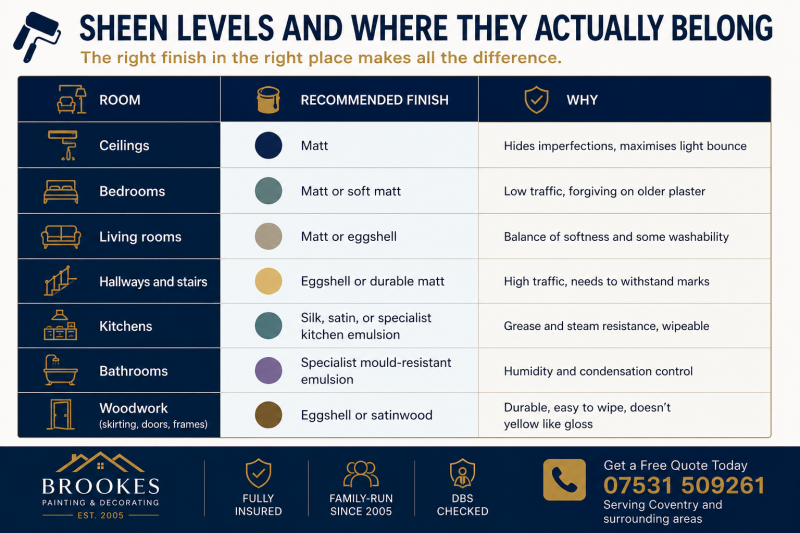
Treating the whole house as one finish is a common shortcut that shows up as premature wear in exactly the rooms — kitchens, hallways, bathrooms — that need the most protection.
A Real Example: A 1930s Semi in Stoke
One recent job involved a 1930s semi in Stoke where the previous owner had applied silk emulsion directly over old gloss-painted woodwork and uneven plaster patches from a removed fireplace. The silk finish highlighted every repair mark under afternoon sun through the bay window. The fix wasn't a better paint — it was proper prep: skimming the patched area level, sanding back the old gloss to give the new eggshell something to key into, and switching from silk to a soft matt on the walls to reduce glare and hide the underlying imperfections that couldn't be fully removed without replastering the whole wall. The lesson generalises: paint problems that look like a product issue are very often a preparation issue in disguise.
FAQ
Q: How many coats do I need on freshly plastered walls in Coventry? A: New plaster is porous and alkaline. Always start with a mist coat (emulsion diluted 10:1 with water) before applying two full coats. Skipping this causes peeling and uneven absorption.
Q: Can I use the same paint in my bathroom as my living room? A: Not ideally. Bathrooms need a paint with mould-inhibiting properties. Most standard emulsions will blister within a year in a room with poor ventilation.
Q: How long should I wait after plastering before painting? A: Fresh plaster needs at least 4–6 weeks to dry fully in normal Coventry conditions. In a damp autumn or winter, allow longer. Painting too early traps moisture and causes problems.
Q: What paint brands do Brookes Painting & Decorating use? A: We use high-quality trade paints from trusted brands depending on the job. For most interiors, Dulux Trade is our baseline. For clients wanting premium finishes, we work with Farrow & Ball, Little Greene, and Zoffany.
Q: Should I paint before or after new carpet or flooring goes in? A: Always paint first. Painting after flooring risks drips and splashes on a finished surface, and skirting boards are easier to cut in cleanly before carpet is fitted.
Choosing paint is only half the job. Surface preparation, the right primer, and correct application technique determine whether a paint job lasts two years or ten. If you're planning a wallpaper feature wall alongside your paint job, our wallpaper installation guide for Coventry homes covers what to know before you choose a pattern. You can also see examples of our recent work on our photos page and read what past clients have said on our reviews page.
If you're based in Coventry, Kenilworth, Leamington Spa, or Warwick and want a professional opinion before you buy a drop, we offer free consultations. Call 07531509261 or get in touch through our contact page.
Brookes Painting & Decorating — family-run since 2005, fully insured, DBS checked.