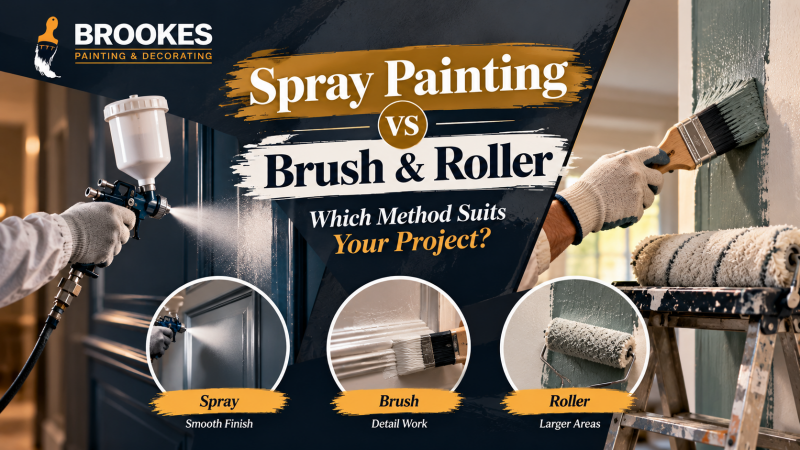
Homeowners occasionally ask why a quote for spray application differs from a standard brush and roller job, or assume spraying is automatically the faster, better choice for every surface. Neither assumption is quite right. Each application method suits different surfaces, finishes, and settings, and choosing the wrong one for a given job can actually cost more time and produce a worse result than the method that's often assumed to be slower or more basic.
How Brush and Roller Application Works
Brush and roller remains the standard method for the vast majority of residential decorating across Coventry, and for good reason. Rollers apply paint quickly and evenly across large flat areas like walls and ceilings, while brushes handle cutting in at edges, corners, and detailed woodwork that a roller can't reach cleanly. This combination gives a decorator precise control over coverage, particularly important around fixtures, switches, and the countless small junctions found in a typical room, and it allows work to proceed room by room without the extensive masking and containment a spray job requires.
How Spray Application Works
Spray application uses an airless or HVLP (high volume, low pressure) sprayer to atomise paint into a fine mist, applied in sweeping passes across a surface. It excels on large, uniform areas and on surfaces with a lot of detail or texture that would be slow and labour intensive to cut in by hand, such as spindles, intricate mouldings, radiators, or louvred doors. Spray application also gives an exceptionally smooth, factory like finish on flat surfaces like doors and kitchen cabinetry, free of the subtle texture a roller or brush can leave behind.
Why Spraying Isn't Always Faster Overall
Spray application itself is often genuinely faster than brush and roller for the actual paint application, but the preparation required changes that calculation considerably. Spraying demands extensive masking of anything not being painted, floors, windows, light fittings, furniture, since overspray travels further and settles more widely than a controlled brush stroke. In an occupied room full of furniture and fixtures, this masking time can exceed any time saved during the spraying itself, which is why spray application makes more sense for certain settings than others, covered below, rather than being a universal faster option.
Where Spray Application Makes the Most Sense
Kitchen cabinetry and furniture. Doors and drawer fronts removed and sprayed in a controlled space, rather than in situ, consistently achieve the smoothest, most professional looking finish, free of brush marks, a popular and growing request across Coventry kitchens being refreshed rather than fully replaced.
New build or empty properties. Properties without furniture, carpets, or existing fixtures to mask around are ideal candidates for spray application, since the usual masking burden is dramatically reduced, letting spraying's speed advantage come through fully.
Exterior render and masonry on a large scale. Spraying can cover large expanses of render considerably faster than rolling, provided adjacent windows, doors, and surfaces are properly masked and weather conditions, particularly wind, are suitable, since wind carries overspray further than most people expect.
Radiators, spindles, and detailed joinery. Anything with a complex shape that would take considerable time to cut in by hand with a brush is a strong candidate for spraying, provided the surrounding area can be adequately protected.
Where Brush and Roller Remains the Better Choice
Occupied rooms with furniture and fixtures. The masking burden for spraying an occupied living room, bedroom, or hallway with furniture still in place generally outweighs any speed benefit, making brush and roller the more practical and often faster overall choice in real world residential conditions.
Small, single rooms or feature walls. Spray equipment setup and cleanup time doesn't scale down well for a small, single room job, where brush and roller can often be quicker from start to finish once setup and masking time for spraying is accounted for.
Jobs needing precise colour changes mid project. Switching spray equipment between colours takes longer to clean and reload than simply switching to a different roller tray, making brush and roller more practical where several different colours are needed across a single visit.
Finish Quality: What Actually Differs
A well executed brush and roller job and a well executed spray job, using quality materials and proper technique, both produce a durable, attractive finish, and most homeowners wouldn't be able to tell the two apart on a standard wall from across a room. The genuine quality difference shows up at close inspection on flat, glossy surfaces like doors and cabinetry, where spray application eliminates the subtle stipple texture a roller leaves and any risk of visible brush marks on a gloss or satin finish, which is why spraying has become the preferred method specifically for kitchen cabinetry refreshes rather than for walls generally.
Masking and Protection: Why It Matters So Much for Spraying
Proper masking before any spray work isn't an optional extra, it's the single factor that determines whether a spray job goes smoothly or creates significant cleanup problems and potential damage to anything left unprotected. This includes floor protection well beyond the immediate work area, since fine overspray travels further on air currents than liquid paint from a brush or roller ever would, taping and covering fixtures, switches, and door furniture, and, for exterior spraying, careful assessment of wind conditions and neighbouring properties before work begins, since overspray drifting onto a neighbour's car or washing line is a genuinely avoidable problem with proper planning.
Ventilation and Safety Considerations
Spray application releases significantly more airborne paint particles into a space than brush and roller application, which makes ventilation and appropriate respiratory protection a bigger consideration for anyone carrying out the work, and for anyone remaining in or near the property during spraying. For occupied homes, this often means arranging for the household, and particularly anyone with respiratory sensitivities, to be away from the immediate work area while spraying takes place and for a reasonable period afterward while the space ventilates. The British Coatings Federation publishes general safety guidance on paint application methods relevant to anyone wanting more detail on this aspect of spray work specifically.
Equipment and Training: Why This Isn't a Simple DIY Swap
Spray equipment, whether airless or HVLP, requires proper training to use effectively, incorrect technique produces an uneven finish, runs, or excessive overspray far more easily than a comparable mistake with a brush or roller. Equipment also needs proper cleaning and maintenance between jobs to avoid clogged nozzles and inconsistent spray patterns, and different paint products need different tip sizes and pressure settings to atomise correctly. This combination of technique and equipment knowledge is part of why professional spray application, done well, delivers noticeably better results than an inexperienced first attempt with hired equipment.
How We Decide Which Method to Recommend
We assess each project on its specific circumstances rather than defaulting to one method across every job: the surface and substrate involved, whether the room is occupied or empty, the finish quality the client is looking for, and practical factors like weather for exterior work or ventilation for occupied interior spaces. Being upfront about which method suits a specific job, and why, rather than defaulting to whichever is more convenient for us, is part of the same honest, assessment led approach covered in our broader guide to choosing a trustworthy painter and decorator in Coventry.
Combining Both Methods Within a Single Project
Many real projects use both methods within the same job, spraying cabinetry doors removed to a controlled space while cutting in walls and skirting by brush and roller in situ, for instance. This combined approach, choosing the right tool for each specific element of a project rather than committing a whole job to a single method, generally produces the best overall result, relevant to the kind of kitchen and bathroom refresh projects covered in our property maintenance and kitchen and bathroom guide.
A Recent Project Example
A recent kitchen refresh in Earlsdon involved spraying the existing cabinet doors and drawer fronts, removed to a controlled workspace, to achieve a smooth, factory finish on a kitchen the client wanted to refresh rather than fully replace. The surrounding walls, skirting, and woodwork were finished by brush and roller in situ, since the kitchen remained in daily use throughout much of the project and full spray masking across an occupied, furnished room would have added considerably more time than it saved. The combined approach delivered the specific smooth finish the client wanted on the most visually prominent element, the cabinetry, without the disruption a full spray approach across the whole room would have caused.
Frequently Asked Questions
Q: Is spray painting always faster than brush and roller? A: Not necessarily. The spraying itself is often faster, but the extensive masking required in an occupied, furnished space can offset or exceed that time saving.
Q: Why do you recommend spraying for kitchen cabinets specifically? A: Spraying gives a smooth, factory like finish free of brush marks on flat, glossy cabinet surfaces, which is harder to achieve consistently with a brush or roller.
Q: Is spray application safe to be around during the work? A: It releases more airborne particles than brush and roller application, so we typically recommend the household avoid the immediate work area during and shortly after spraying for comfort and safety.
Q: Can you combine spraying and brush and roller within the same job? A: Yes, this is common, spraying removable elements like cabinet doors in a controlled space while using brush and roller for walls and fixed surfaces in situ.
Q: Does spray application cost more than brush and roller? A: It depends on the specific job, the masking and setup required, and the surfaces involved, which is why we assess and recommend the right method for each project individually rather than applying a blanket approach.
Get the Right Finish for Your Coventry Project
Choosing the right application method matters as much as choosing the right paint. Brookes Painting & Decorating has used both spray and traditional brush and roller application across Coventry projects since 2005, recommending whichever genuinely suits your specific job. Get in touch through our contact page or call 07531509261, or see examples of recent projects on our photos page.